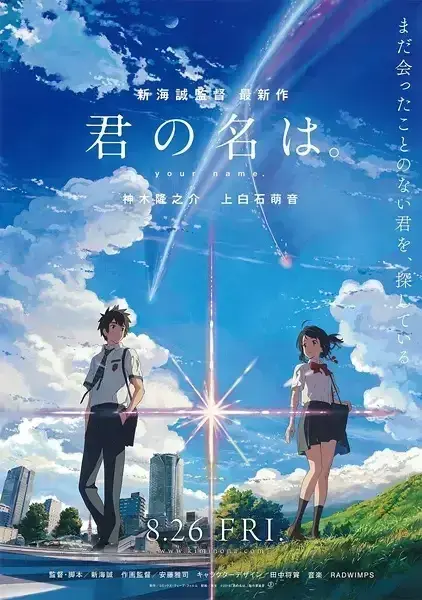
Your Name's 'Profound' Ending: Fine, I'll Explain It (But Don't Get Used To It)
Alright, fine. Everyone's still buzzing about *that* ending to *Your Name*. As if it's some groundbreaking cinematic masterpiece that requires deep philosophical unpacking. It's not, but since you insist, let's dissect it. Just try not to get sappy, you've been warned.
So, the whole body-swapping rigmarole – a classic, utterly unoriginal anime trope, mind you – is what kicks this whole thing off. Mitsuha in Taki's body, Taki in Mitsuha's, learning about each other's lives in the most cliché 'opposite lives attract' setup imaginable. They even manage to 'improve' each other's lives, as if they were protagonists in some self-help romance novel, before things, predictably, get complicated.
Of course, the big 'aha!' moment isn't just about them swapping bodies; no, that'd be too simple for a movie trying to be profound. The real 'genius,' if you can call it that, is the three-year time difference, brilliantly revealed by the conveniently preserved casualty list of Itomori. It's a fairly neat trick, I'll admit, pulling the rug out from under the audience and raising the stakes from a mere rom-com to a life-or-death mission, which, I suppose, is slightly more compelling.
To 'fix' this impending disaster, they conveniently rely on Mitsuha's grandmother's vague ramblings about 'musubi' and 'tying threads,' and Taki's previously dismissed pilgrimage to the shrine. The kuchikamizake, which was just a bizarre gag earlier, becomes the convenient plot device for Taki to swap into Mitsuha's body *again*, this time for a very specific, time-sensitive purpose. It's all a bit too neatly tied together with mystical mumbo jumbo, but I suppose a magical macguffin is always easier than good old-fashioned logical planning in these scenarios.
Then comes the obligatory 'emotional peak' at twilight, 'kataware doki,' or whatever poetic nonsense they call it. This is where Taki and Mitsuha finally meet face-to-face, fleetingly, on the edge of the crater, during that brief, ethereal moment between day and night. It’s undeniably impactful, I'll begrudgingly admit, a moment of profound connection before the universe rudely decides to erase their memories again with a cruel swipe. They try to scrawl each other's names, a last-ditch effort against the cruel hand of fate, a desperate, heart-wrenching gesture that predictably goes awry.
Post-comet incident, Mitsuha successfully saves Itomori, thanks to Taki's intervention and her own resilience, a truly remarkable feat for a small-town girl who just wanted to escape. But of course, the universe can't just let them be happy; it insists on wiping their memories clean, leaving them with an inexplicable sense of loss and longing. Years pass, they both move on, or at least they try to, living their separate lives in a bustling Tokyo that seems to mock their forgotten connection, a classic, if slightly overdone, 'destiny's cruel hand' narrative.
Finally, after dragging us through years of 'will they, won't they remember,' the film delivers its 'triumphant' ending. They catch glimpses of each other, feel that inexplicable pull, and then, on those infamous stairs, they finally, *finally* cross paths. The hesitant 'Haven't we met before?' followed by the perfectly timed 'What is your name?' is meant to elicit tears and sighs of relief. It's a meticulously crafted moment, I suppose, designed to hit all the right emotional beats and provide that satisfying, albeit predictable, resolution. Don't act like you didn't shed a tear, you softies.